6 Best Legal CRM Software Options for Law Firms October 2026

You already know the pain: a lead comes in, gets logged in one tool, then someone copies it into your case system, then into your payment setup, then into whatever tracks court notices. Most legal CRM software only covers one piece of that chain. We lined up seven of them and focused on the thing that matters once you're moving real client volume. How much of the client lifecycle each one actually carries before handing you back a manual mess.
TLDR:
- Legal CRM software runs from front-end intake tools to full case systems, so match the tool to your caseload
- For high-volume firms, lifecycle coverage and workflow automation depth matter most, because handoffs break at volume
- Clio, Lawmatics, Smokeball, Filevine, and Intaker each own one slice of the client lifecycle and hand off the rest
- No general legal CRM ships native bankruptcy petition or schedule prep, forcing a separate schedules tool and duplicate entry
- Glade AI carries a client end-to-end for 2+ attorney bankruptcy firms, with native payments and setup in days
What Is Legal CRM Software? (And Why Most Tools Cover Only One Slice)
Legal CRM software is the system a firm uses to capture leads, track prospective and current client relationships, automate intake and follow-up, and keep client data in one place across the caseload. That is the functional definition. The complication is scope. The legal CRM category runs from front-end intake and marketing tools to full case management systems, which is why a single search surfaces very different products side by side.
For a high-volume bankruptcy firm, the question is narrower. You need a single source of truth that carries a client from first inquiry through case completion, not a law firm CRM that only captures leads and hands off the rest.
How We Ranked and Reviewed These Legal CRM Software Tools
This legal CRM software ranking is our assessment, built from publicly available information about each tool. We did not run our own benchmark or lab test. We applied the same criteria to every product so the comparison holds:
- Lifecycle coverage, from lead capture through case completion
- Workflow automation depth
- Native payments
- AI capability
- Practice-area fit
- Integration overhead versus native functionality
- Pricing transparency
For firms managing real client volume, workflow automation depth and lifecycle coverage carry the most weight in choosing legal CRM software. A tool that only captures leads and hands off the rest scores lower than a system that owns the client from first inquiry through filing, because the handoffs are where volume breaks. The ABA 2026 legal industry report found that law firms prefer integrated solutions over fragmented ones, a finding that runs through every tool comparison below. See law automation benefits and use cases for how firms are applying this at scale.
Why Glade AI Outperforms Other Legal CRM Software for Bankruptcy Firms
Most legal CRMs capture leads and stop there. Glade AI is an AI operating system for law firms, built bankruptcy-first, that carries a client end-to-end: intake, document collection, client communication, native payments, case management, and post-filing court management in one unified system. The headline is stack consolidation. One workspace replaces the four to seven disconnected tools most firms glue together to run a single case.

Case Intelligence is the reason it holds together. Your case file builds itself as the work happens. A canonical case data layer keeps every record authoritative, so the CRM, workflows, and reporting all operate on the same source of truth instead of drifting across systems.
Core strengths:
- AI agents for document analysis, client triage, and task routing
- Single-entry data propagation across 21+ linked fields
- Native Stripe and Confido payments with automated payment-plan reminders
- Conversational AI intake that books consultations in real time
- Event-driven workflow engine that fires actions on real client events
- Setup in days
Bottom line: For 2+ attorney firms scaling client volume without adding headcount, Glade is the system to run the whole caseload on.
Clio
Clio is one of the most widely used generalist legal case management and CRM systems, serving firms across every practice area with a large integration ecosystem, a client portal, native payments, and a general-purpose AI assistant, Clio Manage AI. It is a flexible, well-supported system of record that suits multi-practice firms wanting broad coverage, such as billing, matter management, calendaring, and document storage, over deep vertical specialization. (Based on publicly available information as of July 2026.)
What They Offer
- Case management and CRM (Clio Grow) across all practice areas
- Clio Connect client portal for document sharing and messaging
- A large third-party integration marketplace
- Clio Manage AI general-purpose AI assistant
Good for: Multi-practice firms that want broad, general-purpose case management and a wide integration ecosystem.
Limitation: Clio works well as a horizontal system, but it lacks native bankruptcy features like credit-report pulls, means-test calculation, and petition prep. Bankruptcy firms typically pair it with a separate tool such as Best Case, which means duplicate data entry between the two.
Bottom line: For general-practice firms wanting one flexible system, Clio is a reasonable fit. Firms carrying real bankruptcy volume get more from Glade AI's purpose-built workflows and native petition and schedule preparation, which remove the multi-tool stack entirely.
Lawmatics
Lawmatics is a legal CRM and marketing-automation platform built for the front of the firm: client intake, lead tracking, follow-up, and marketing analytics. Founded by a team that included practicing attorneys, it puts intake and marketing automation at the center instead of bolting CRM on as an afterthought, and its AI-powered lead qualification, engagement, and communication tools are live across all current plans, per a 2026 Lawmatics review. (Based on publicly available information as of July 2026.)
What They Offer
- Custom intake forms that embed on a firm's website
- Legal CRM for lead and client interaction tracking
- Marketing automation and reporting dashboards
- Merlin Qualify (formerly QualifyAI) for AI-powered lead scoring and follow-up
Good for: Firms whose main bottleneck is growth and lead conversion, not post-signing case management.
Limitation: Lawmatics works well for the pre-client lifecycle, but its post-signing case management depth is limited and it cannot run calculations between fields, a critical gap for bankruptcy firms that need to calculate means-test figures, exemptions, and schedule totals natively. Bankruptcy firms must export data to a separate schedules tool to produce these figures.
Bottom line: Lawmatics is a capable intake and marketing tool. For firms that want one system carrying a client from lead capture through case completion with native calculations and payments, Glade AI is the better choice.
Smokeball
Smokeball is a legal practice management system built around automatic time capture, billing, document automation, and matter management. It comes in tiered plans, namely Bill, Boost, Grow, and Prosper+, with pricing available on request. (Based on publicly available information as of July 2026.)
What They Offer
- Automatic time tracking and legal billing
- Document automation and matter management
- Secure client portal on higher tiers
- Practice-area templates and workflow tools on premium plans
Good for: Small general-practice firms wanting strong automatic time capture and document automation for hourly-billing work.
Limitation: Smokeball works well for hourly-billing firms, but workflow automation, lead management, and intake are gated to higher tiers. It is a generalist legal CRM without native bankruptcy petition prep, credit-report ingestion, or means-test calculation, so bankruptcy firms will still need a separate schedules tool and will face the same multi-system data re-entry Smokeball was meant to simplify.
Bottom line: Smokeball fits document-heavy hourly-billing firms. Glade AI suits high-volume bankruptcy practices needing bankruptcy-specific automation and native filing in one system.
Filevine
Filevine is an AI-driven legal case management system built primarily for personal injury, with deeply configurable matter management and its own AI products, including ImmigrationAI for immigration workflows and Outlaw for contract review.
What They Offer
- Highly customizable case and matter management
- Filevine Client Portal for document sharing and messaging
- AI products for immigration (ImmigrationAI) and contract lifecycle management (Outlaw)
- Configurable templates and workflows
Good for: Personal injury firms wanting a configurable case system built around their vertical.
Limitation (based on publicly available information as of July 2026): Filevine works well for personal injury but ships with no bankruptcy-specific workflows out of the box. Going live takes extensive configuration, and pricing is custom and requires a sales call. Its AI products, ImmigrationAI and Outlaw for contract review, are built for PI and immigration workflows, not bankruptcy. To run means-test math or petition schedules, a firm still has to add a separate schedules tool and re-key the same data between systems, the exact multi-tool handoff a high-volume legal CRM should eliminate.
Bottom line: Filevine fits PI firms well. For bankruptcy practices needing Chapter 7 and Chapter 13 workflows, credit-report pulls, and means-test calculation out of the box, Glade AI is the better choice.
Intaker
Intaker is an AI chat and intake-automation tool for law firm websites. It sits at the top of the funnel, catching and qualifying leads before they reach a human.
What They Offer
- AI chatbot for website lead qualification
- Automated intake forms
- Initial client-contact capture
- Website engagement widgets
Good for: Firms that want to improve website lead capture and qualification at the top of the funnel.
Limitation (based on publicly available information as of July 2026): Intaker covers the lead-capture and initial intake stage and hands off to whatever case management system a firm already uses; it is designed to plug into, not replace, downstream tools. Case creation, task assignment, and post-intake workflows depend on the connected case system, not Intaker itself.
Bottom line: Intaker is useful for catching leads. Glade AI captures the lead and then runs the case through workflows, payments, and completion without a manual handoff, making it a full legal CRM for bankruptcy firms instead of a single-stage funnel tool. See how it compares in our guide to AI solution for bankruptcy firms.
Legal CRM Software Comparison: Features That Matter at Volume
Here are the capabilities that matter most once a firm is carrying real client volume, side by side. Based on publicly available information as of July 2026; individual product capabilities and tiers change, so confirm current features directly with each vendor before making a purchasing decision.
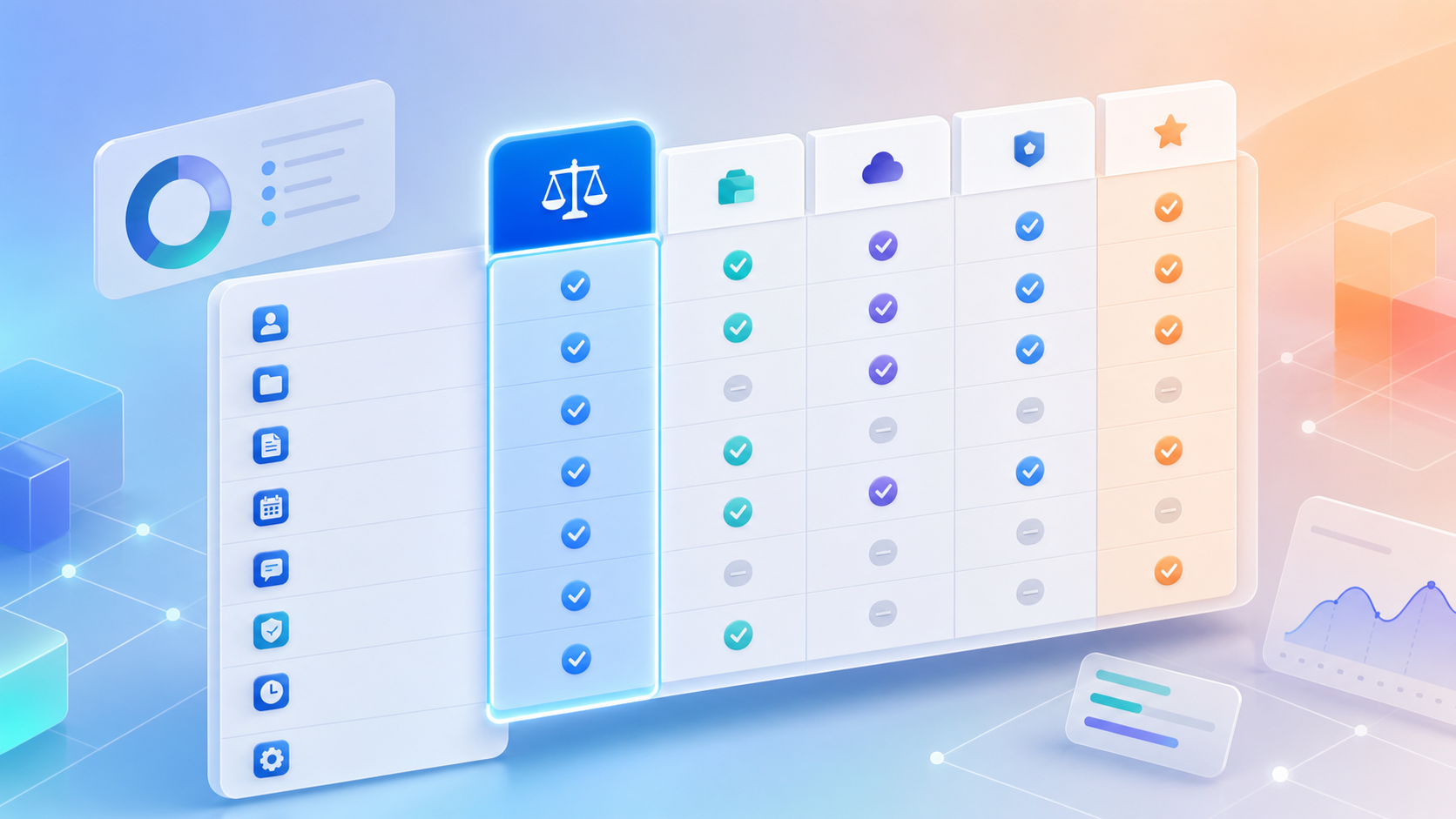
Feature | Glade AI | Clio | Lawmatics | Smokeball | Filevine | Intaker |
|---|---|---|---|---|---|---|
End-to-end lifecycle (lead to case completion) | Yes | Partial | No | Partial | Partial | No |
Native workflow automation | Yes | Partial | Partial | Partial | Yes | No |
Bankruptcy-specific petition/schedule prep | Yes | No | No | No | No | No |
Native payments | Yes | Yes | No | Yes | No | No |
Production AI agents | Yes | Partial | Partial | No | Partial | Partial |
Setup time | Days | Weeks | Weeks | Weeks | Weeks+ | Days |
Head-to-Head Legal CRM Comparison: Why Glade AI Wins on Lifecycle Coverage
The comparison table above makes the split clear: every other tool marks Partial or No on end-to-end lifecycle coverage, and Glade AI is the only row that carries a client from lead through case completion.
For 2+ attorney firms carrying real bankruptcy volume, that consolidation is the difference between scaling and burning out staff. See how Glade automates the full client lifecycle from intake through filing on the Glade bankruptcy page.
How to Choose the Right Legal CRM Software for Your Firm
Each legal CRM tool here fits a real firm and a real need, so the question is which slice of the client lifecycle you actually need covered. For bankruptcy practices carrying serious volume, a system that owns intake through filing beats gluing five tools together and syncing them by hand. Book a Glade AI demo.
FAQs
Is Glade AI or Clio the better legal CRM for a bankruptcy firm?
Clio works well as a horizontal case management system for multi-practice firms wanting broad coverage and a large integration ecosystem, but it lacks native credit-report pulls, means-test calculation, and petition prep. A firm carrying real bankruptcy volume gets more from Glade AI's purpose-built Chapter 7 and Chapter 13 workflows, since Clio users typically pair it with a separate tool like Best Case and re-enter data between the two.
How do I choose the right legal CRM from this list for my firm?
Start by looking at your highest-volume case type and how much of the client lifecycle each tool actually owns. Front-of-funnel tools like Lawmatics and Intaker fit firms whose bottleneck is lead conversion, generalist systems like Clio and Smokeball fit multi-practice firms, and Glade AI fits 2+ attorney bankruptcy practices that need one system from intake through filing.
Which legal CRM works best for a firm focused on lead capture instead of full case management?
Lawmatics and Intaker both focus on the top of the funnel. Intaker suits firms wanting a website chatbot to qualify leads, while Lawmatics adds custom intake forms and marketing automation, though both hand off to a separate case system once a client signs.
Can Filevine or Smokeball handle bankruptcy petition and schedule prep?
No. Filevine is built primarily for personal injury and Smokeball for hourly-billing general practice, so neither ships with bankruptcy petition prep, credit-report ingestion, or means-test calculation. Bankruptcy firms using either would need a separate schedules tool, which is the multi-tool stack Glade AI is built to replace.
Why does end-to-end lifecycle coverage matter more than lead capture for a high-volume firm?
The handoffs between tools are where volume breaks: every export, re-key, and system switch creates a point of failure and duplicate data entry. A tool that only captures leads and hands off the rest scores lower for a high-volume firm than one that carries a client from first inquiry through case completion on a single source of truth.